
Analysis: North Carolina’s recovery effort on repeat one year after Hurricane Helene
It has been a year since Hurricane Helene wreaked havoc on the western region of our state, where several thousand North Carolinians were left without stable housing, adequate public infrastructure, viable access to healthy food and care, employment security and even minimal state recovery support. It is important to also note that natural disasters are especially burdensome for residents who are differently abled, individuals making ends meet with low incomes or living in rural areas. A lot of them are from Black, Indigenous, Latine and Asian American Pacific Islander communities, among others of the global majority.
Recovery efforts have been heavily dependent on the kindness and diligence of volunteer networks and community organizations, philanthropic giving and regional support. But there remains an enormous gap in resources still required in order for folks to make a full recovery.
Disaster recovery and relief are ongoing investments, not one-off solutions — because the unfortunate reality is in a state like North Carolina, it is not a matter of if our communities will be impacted by a natural disaster but simply a matter of when. In order for us to accurately claim we are a resilient state, we need long-term, sustained investment in quality infrastructure and community-based operations.
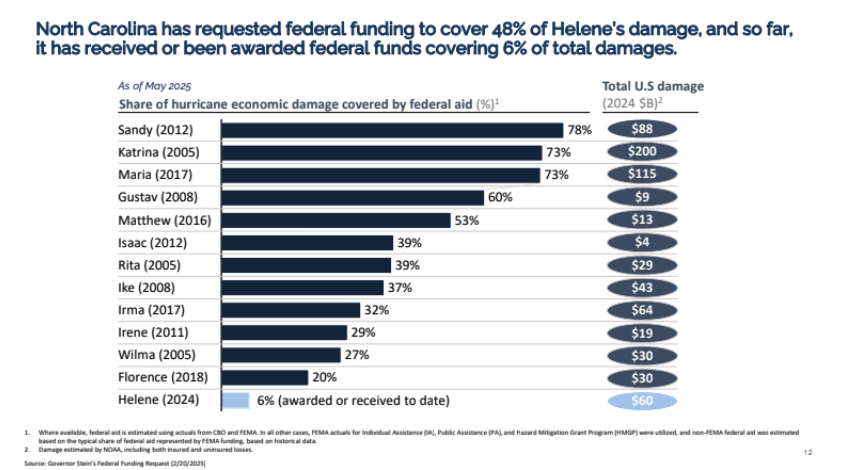
Although this is the one-year remembrance of Helene, we would be remiss for not also highlighting the historic divestment over the past several years, especially dating back to the disaster Hurricane Katrina leveled in 2005. It is no coincidence the divestment is particularly prevalent in the southeastern region of the United States, where the highest concentration of Black and Brown people reside. Specific to North Carolina, we still have neighbors in the eastern part of the state who have yet to recover from Hurricane Florence and Hurricane Matthew due to poor policy decisions and unnecessary administrative burdens created by the failed ReBuild NC program, which left some survivors in limbo, preventing them from accessing the additional recovery support they needed. Those communities are predominantly Black and Brown, too. The irony there is not lost.
Recovery after Matthew and Florence wasn’t slowed by policy mishaps alone—it was also hindered by a lack of sensitivity to historic barriers facing Black and Brown communities, like limited SBA credit, heir’s property, and lack of access to legal counsel. These inequities required new policy fixes, even litigation, before help reached those most impacted. As we remember Hurricane Helene, we also call for an inclusive recovery across our entire state.
True recovery means that those most burdened by these issues are the ones who must benefit from the policy, which requires deeper community engagement and feedback in shaping the response. As we remember Hurricane Helene, we also call for this definition of inclusive recovery.
Jovita Lee, Ed.D., is program director for North Carolina Black Alliance, a statewide, independent, Black-led, 501(c)(3) organization building political and economic power in Black communities and institutions in North Carolina. Yolanda Taylor is the organization’s program attorney.